





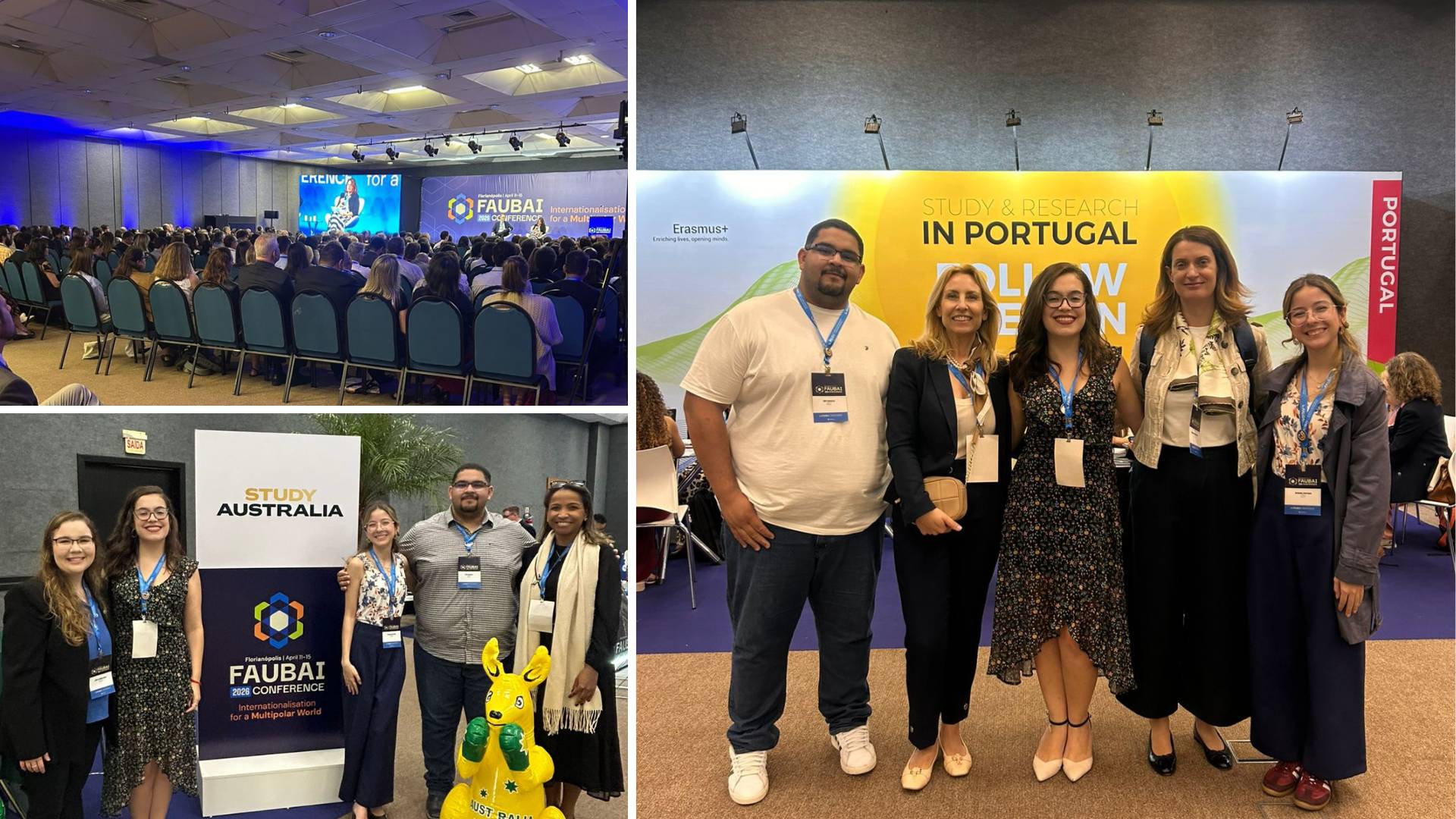
Participation in the leading event in this field in Latin America fosters new partnerships, facilitates the exchange of experiences, and paves the way for future institutional advancements
The University Center of Jaguariúna (UniFAJ) participated in FAUBAI 2026, an annual fair organized by the Brazilian Association of International Education, held from April 12 to 15 in Florianópolis (SC). The institution’s participation reinforced its commitment to the internationalization of higher education and opened doors to new academic connections around the world.
Considered the largest event on the internationalization of higher education in Latin America, the conference brought together universities, consulates, organizations, and experts from various countries to discuss trends, challenges, and opportunities in the global landscape.
For Ana Carolina Faustini, coordinator of the institution’s Bilingual Program, participation was strategic both for institutional strengthening and for staff training. “Participating in this event was very positive—an excellent training opportunity—because, in addition to strengthening our network, we had the chance to engage with researchers and global leaders discussing trends, science diplomacy, and paths to internationalization,” she notes.
Global Connections and New Opportunities
During the fair, UniFAJ established and strengthened ties with institutions from various countries, including Canada, Chile, Peru, France, the United States, Russia, and Australia. Among the highlights were international interest in innovative initiatives developed by the institutions, such as digital exchange programs and the COIL (Collaborative Online International Learning) model, as well as recognition for joining Global Partners in Education, as the network’s sole Brazilian representative.
Another important development was the establishment of partnerships with leading universities and organizations, such as U.S. institutions with a high degree of international diversity, European business schools, and globally prominent online universities. There were also advances in institutional partnerships, including connections with Study Australia and initiatives linked to the University of Sydney. “Internationalization goes far beyond student mobility. It connects teaching, research, and community outreach, strengthens the academic community, and can transform people’s life trajectories,” emphasizes Ana Carolina.
Another highlight of the participation in FAUBAI 2026 was the presentation of the Bilingual Program and the institutions’ language policy to the international academic community, underscoring their commitment to preparing professionals for global contexts. The initiative was presented as an innovative project based on the integration of language, content, and culture in higher education, aligned with active learning methodologies, Content and Language Integrated Learning (CLIL), and the development of intercultural competencies.